How Do I Store and Protect My Sports Cards?
Richard WeissKey Takeaways
- Sleeve first. Every card you want to keep goes in a penny sleeve before it goes into a toploader, a one-touch or a semi-rigid holder.
- Use toploaders for storage and handling, one-touches for display, and semi-rigid holders for grading submissions. PSA says not to send cards in toploaders.
- The U.S. National Archives says to keep paper items below 75 degrees Fahrenheit and below 65% relative humidity, and to avoid humidity under 15%.
- Keep cards out of damp basements, garages and hot attics.
- Light damage is cumulative and irreversible, so keep cards out of direct sunlight even in a UV-rated holder.
Table of Contents
To store and protect sports cards, put each card in a penny sleeve, put the sleeved card in a rigid holder, and keep it in a cool, dry, dark place inside your living space. The holder stops scratches and bends. The room stops humidity, heat and light from doing slower damage.
This post covers holders and environment. For sorting, labeling and cataloging, read how to organize sports cards.
Which Holder to Use
Each holder does a different job. Most cards use two at once, i.e. a soft sleeve inside a harder holder.
| Holder | Best for | What to know |
|---|---|---|
| Penny sleeve | Every card you want to keep. It is the first layer. | Thin and soft. The BCW card sleeves we carry are acid-free polypropylene and come 100 to a pack. |
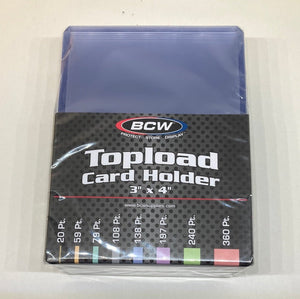
| Toploader | Storing and handling single cards | Rigid plastic that stops bends. Sleeve the card first. BCW lists its standard 3" x 4" toploader as rigid PVC. We carry the BCW toploader 25-pack. |
| One-touch (magnetic holder) | Displaying your best raw cards | Two-piece holder with a magnetic closure. Ultra PRO says its UV ONE-TOUCH uses UV-blocking additives and non-PVC materials. Match the holder to the card's thickness. |
| Semi-rigid holder (Card Saver) | Sending cards to a grading company | Stiffer than a sleeve, more flexible than a toploader. PSA asks for a clear penny sleeve inside a semi-rigid holder and says not to use toploaders. |
Shop card sleeves and toploaders, or see the full kit in our must-have accessories for sports card collectors. If you seal or brand your holders, we also carry one-touch and toploader stickers.
Sleeve First
A rigid holder protects against bends, but an unsleeved card can slide around inside it and pick up surface wear. The sleeve is what touches the card, so it matters what the sleeve is made of.
The National Archives lists polyester, polypropylene and polyethylene as stable plastics for sleeves and pages, and advises against unknown plastics and PVC. For sleeves and binder pages, look for polypropylene and "acid-free" on the maker's spec.
Fit matters too. Thick memorabilia and patch cards need a holder made for their thickness. Do not force a thick card into a standard holder.
Storage Boxes
Boxes keep cards upright, dark and dust-free. Two things to check before you buy:
- What the box is built to hold. BCW's 800 Count Storage Box is made for loose and sleeved cards, and BCW states it is not designed to fit toploaders, magnetic holders or slabs. Cards in rigid holders need a box sized for them.
- What the box is made of. The Library of Congress recommends acid-free and lignin-free boxes for paper items. If long-term storage is the goal, look for those words on the maker's spec.
Do not overfill a row. Cards that are packed tight get corner and edge wear when you pull them out. Keep boxes on a shelf, not on the floor, so a leak does not reach them. The National Archives gives the same advice for family papers.
Temperature and Humidity
Cards are paper. Preservation guidance for paper applies to them directly.
| Source | Temperature | Relative humidity |
|---|---|---|
| U.S. National Archives | Below 75 degrees Fahrenheit. Cooler is better. | Below 65% to prevent mold. Not below 15%, which can cause brittleness. |
| Library of Congress | Room temperature or below | About 35% |
What that means at home:
- Store cards in a room you live in, i.e. a closet or shelf in a climate-controlled part of the house.
- Avoid damp basements, garages and hot attics. The National Archives names all three, and the Library of Congress also says to avoid attics and basements.
- Keep boxes away from sources of leaks, such as pipes, windows and known roof leaks.
- Aim for stable conditions. The Northeast Document Conservation Center (NEDCC) notes that wide swings in temperature and humidity can damage collections.
- If you are not sure about a room, NEDCC suggests starting with a simple thermohygrometer to monitor temperature and humidity.
Light
NEDCC states that light damage is cumulative and irreversible. The Library of Congress recommends minimal exposure to all kinds of light and no exposure to direct or intense light.
- Store most of your collection in boxes or binders, where it is dark.
- Display cards away from windows and direct sunlight.
- A UV-rated holder is not a reason to leave a card in the sun. The Library of Congress guidance covers all kinds of light, not only UV.
Handling
- Wash and dry your hands first. The Library of Congress lists clean hands and a clean work area as the first step in handling paper.
- Hold cards by the edges and keep food and drinks away.
- Sleeve a card as soon as it comes out of the pack if you plan to keep it.
- Do not use rubber bands on cards. The National Archives lists them among materials to avoid.
Thinking about grading your best cards? Read how to grade your sports cards.
Sources
- U.S. National Archives: Storing Family Papers and Photographs
- Library of Congress: Care, Handling and Storage of Works on Paper
- NEDCC: Temperature, Relative Humidity, Light, and Air Quality
- PSA: Card Packaging Guidelines
- BCW: Standard Card Sleeves
- BCW: 3x4 Topload Card Holder
- BCW: 800 Count Storage Box
- Ultra PRO: 35PT UV ONE-TOUCH Magnetic Holder
Shop the Setup
Gear from this article — custom-printed and shipped in 2–4 business days.