How Do I Grade My Sports Cards?
Richard WeissKey Takeaways
- To grade a card, you send it to a grading company. It is authenticated, graded on a 1 to 10 scale and sealed in a labeled holder called a slab.
- Graders judge four things: centering, corners, edges and surface.
- The top grade has a different name at each company: GEM-MT 10 at PSA, 10 PRI (Pristine) at SGC, and Pristine 10 at CGC Cards and TAG.
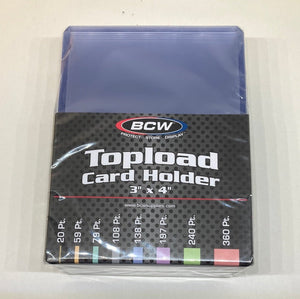
- PSA asks for each card in a clear penny sleeve inside a semi-rigid holder and says not to use toploaders.
- As of October 6, 2026, Beckett.com is offline. Beckett's notice says Express grading submissions are open through a temporary form and Base and Standard submissions are paused.
Table of Contents
You grade a sports card by submitting it to a third-party grading company such as PSA, SGC, CGC Cards or Beckett (BGS). The company checks that the card is real, grades its condition on a 1 to 10 scale, and seals it in a holder with the grade on the label.
What Is Sports Card Grading?
Grading is a paid condition review by a company that has no stake in the card. The result is a number from 1 to 10 and a sealed holder, called a slab, with a label that shows the card, the grade and a certification number.
Two corrections to how grading is often described:
- A 10 is not "mint." On PSA's scale, MINT is a 9 and GEM-MT (Gem Mint) is the 10. NM (Near Mint) is a 7.
- The label is the record. The grade and a certification number are printed on the slab's label. CGC Cards, for example, has a Verify Certification lookup on its site.
Not every card gets a number. PSA states it will not grade cards that show evidence of trimming, re-coloring, restoration or other tampering, or that are of questionable authenticity.
What Graders Look At
Graders judge four parts of a card. The examples below come from SGC's published grading scale.
| Criterion | What it means | Example from SGC's scale |
|---|---|---|
| Centering | How evenly the borders frame the image | 50/50 for a 10 PRI, 55/45 or better for a 10 GM, 60/40 or better for a 9 |
| Corners | How sharp the four corners are | A 10 needs four sharp corners. Minor rounding or fuzzing shows up in the description of a 5. |
| Edges | Chipping, notching or roughness along the sides | "Slight notching of edges" appears at a 6 |
| Surface | Gloss, scratches, print lines, stains and creases | A 10 is free of stains, with no breaks in surface gloss and no print or refractor lines |
Standards differ slightly by company. CGC Cards allows front centering of approximately 55/45 on a Gem Mint 10 and requires 60/40 or better on a Mint 9 for sports cards. PSA notes that most grading is objective, but graders can make a judgment call based on eye appeal when a card sits between two grades.
Check these four things yourself under a bright light before you pay to grade anything.
Grading Companies Compared
We checked each company's own site on October 6, 2026.
| Company | Grading scale | Top grade name | Source checked |
|---|---|---|---|
| PSA | 1 to 10 | GEM-MT 10 (Gem Mint) | PSA grading standards page |
| SGC | 1 to 10, with half grades | 10 PRI (Pristine), then 10 GM (Gem) | SGC grading scale |
| CGC Cards | 1 to 10, with half grades | Pristine 10, then Gem Mint 10 | CGC Cards grading scale |
| TAG | 1 to 10, plus a 1,000-point TAG Score | Pristine 10, then Gem Mint 10 | TAG grading scale |
| Beckett (BGS) | Not checked. Beckett.com was offline. | See our BGS Black Label glossary entry | Beckett maintenance notice |
PSA's standards page also shows a half-point example (PSA 8.5). TAG says half points are included at every level except between 9 and 10.
Beckett (BGS) Status
As of October 6, 2026, Beckett.com redirects to a notice. It says:
- Beckett's digital platforms, including Beckett.com and the Beckett mobile app, are temporarily offline.
- Express card grading submissions are open through a temporary submission form.
- Base and Standard card grading submissions are temporarily paused.
- Orders Beckett has already received are still being processed.
Because the site is offline, we could not check the BGS grading scale or fees, so we do not list them here. Read Beckett's notice before you send anything.
What Grading Costs
Fees depend on the service level, and the service level depends on the card's declared value. These are the entry points we could confirm on October 6, 2026:
- CGC Cards: Bulk is $17 per card (25-card minimum, cards up to $500 in value, 150 working days). Economy is $20 per card (up to $1,000, 90 working days). Standard is $55 per card (up to $3,000, 10 working days).
- PSA: the Value and Value Bulk levels are listed as currently unavailable. Standard is $59.99 per card (maximum insured value $1,000, estimated 90 to 100 business days).
- SGC: SGC adjusted its service levels effective September 2, 2026. Check SGC's services and pricing page for current fees.
- Beckett: not listed. See the status above.
PSA and CGC Cards both state that turnaround times are estimates and are not guaranteed. Budget for shipping on top of the grading fee.
How to Submit Cards
- Pick the cards. Inspect centering, corners, edges and surface, and leave out anything with an obvious flaw.
- Pick a company and service level. Match the level to each card's declared value.
- Fill out the submission form on the grader's site and include the paperwork it gives you.
- Pack the cards. PSA's instructions: place each card in a clear penny sleeve, slide it into a semi-rigid holder such as a Card Saver 1, and do not use toploaders, tape, pull tabs or sticky notes. Put the stack between two pieces of cardboard.
- Ship it in a sturdy box with tracking.
- Wait. The card comes back in a slab, or without a numeric grade if it did not qualify.
We carry BCW penny sleeves for the first step of packing. For everyday storage after that, see how to store and protect your sports cards.
Is Grading Worth It?
Grading makes sense when the grade is likely to add more than the fee, or when you want a card authenticated and protected for the long term. Before you submit:
- Compare recent sales of the card raw and graded. Our guide on how to find the value of your sports cards shows how.
- Check the pop report to see how many copies already exist in each grade.
- Look at the card's gem rate. If few copies reach a 10, do not count on one.
- Add the fee, shipping both ways and the wait to the math.
Sources
- PSA: Grading Standards
- PSA: Trading Card Grading Services
- PSA: Card Packaging Guidelines
- SGC: Grading Scale
- SGC: Service Level Update
- CGC Cards: Grading Scale
- CGC Cards: Services and Fees
- TAG: Grading Scale
- Beckett: Service Status Notice
Shop the Setup
Gear from this article — custom-printed and shipped in 2–4 business days.