How To Organize Sports Cards: A Comprehensive Guide
Richard WeissKey Takeaways
- Pick one main sorting method and use it for the whole collection: by sport, then by year, set and card number is the standard for set builders.
- Pull rookies, autographs, numbered cards and anything you would hate to damage before you sort the bulk. Those go in sleeves and rigid holders.
- Use storage boxes with labeled dividers for bulk and binders with 9-pocket pages for sets and player collections you want to flip through.
- BCW's 800 Count Storage Box is made for loose and sleeved cards. BCW says it is not designed to fit toploaders, magnetic holders or slabs.
- Catalog as you go in a spreadsheet or an app, and record which box or binder each card lives in.
Table of Contents
The best way to organize sports cards is to pick one sorting method, usually sport, then year, set and card number, and apply it to every card you own. Pull your best cards into sleeves and holders first, put the bulk in labeled boxes or binders, and keep a simple catalog so you can find any card in under a minute.
This guide covers sorting, labeling and cataloging. For holders, humidity and light, read how to store and protect your sports cards.
Choose a Sorting Method
There is no single correct system. The right one depends on why you collect. Pick a primary method, then use a second one inside it, i.e. sport first, then year.
| Sort by | How it works | Best for |
|---|---|---|
| Sport | One box or binder per sport | Anyone who collects more than one sport. Use it as the top level. |
| Year and set | Group by year, then by set, then in card number order | Set builders. Gaps in the numbers show you what is missing. |
| Team | One section per team, then by year or player | Fans of one team or one league |
| Player | One section per player, oldest card to newest | A personal collection (PC) built around a few players |
| Card type | Separate rookie cards, autographs, numbered cards and inserts from base cards | Sellers and anyone who mostly keeps hits |
Whatever you choose, write it down and stick to it. A system only works if every new card goes to the same place the last one did.
Sort in Passes
Sorting a big pile in one go is slow. Break it into passes on a clean, flat table.
- Pull the keepers. Go through every card once and set aside rookies, autographs, numbered cards, memorabilia cards and star players. Put each one in a penny sleeve right away.
- Split by sport. Make one pile per sport.
- Split by year and set. Work one sport at a time. The card back usually shows the manufacturer and the copyright year.
- Put each set in number order. Sort into piles of 100 first (1 to 99, 100 to 199), then order each pile.
- File and label. Move each finished stack straight into its box or binder and label it before you start the next one.
Handle cards by the edges and keep drinks off the table while you sort.
Boxes or Binders
Most collections use both. Boxes hold volume. Binders are for the cards you want to look at.
| Storage | What it holds | Use it for |
|---|---|---|
| Cardboard storage box | Rows of loose or sleeved cards, sold by card count | Base cards, complete sets, duplicates |
| Binder with 9-pocket pages | Nine standard cards per page | Sets and player or team collections you flip through |
| Toploader or graded card box | Cards in toploaders, one-touches or slabs | Your best cards, filed upright in the same order as the rest |
Check what a box is built for before you buy it. BCW's 800 Count Storage Box, for example, is made to hold loose and sleeved standard cards, and BCW states it is not designed to fit toploaders, magnetic holders or slabs. Cards in rigid holders need a box sized for them.
For binders, choose pages made from polypropylene. BCW's 9-pocket pages are acid-free polypropylene and fit a standard 3-ring binder. The U.S. National Archives lists polypropylene as a stable plastic for storage pages and advises against unknown plastics and PVC.
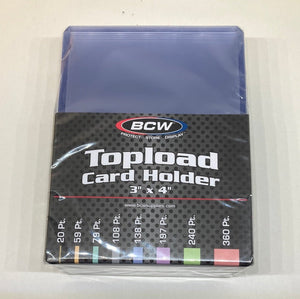
We carry BCW card sleeves and BCW toploaders for the keepers. See everything in card sleeves and toploaders, or read our list of must-have accessories for sports card collectors.
Label Everything
Labels are what turn sorted cards into a system you can use.
- Boxes: label the end that faces out on the shelf with the sport, years and sets inside, i.e. "Baseball 2021 to 2023 Topps."
- Rows: use card dividers between sets, teams or players. BCW's horizontal trading card divider has a fold-over tab made for handwritten or printed labels.
- Binders: label the spine, and keep one set or one player per binder where you can.
- Holders: our one-touch and toploader stickers come in multiple colors, so you can color-code holders by sport or team.
Number your boxes and binders (Box 1, Box 2, Binder A). You will use those numbers in your catalog.
Catalog Your Collection
A catalog tells you what you own and where it is. You can keep it in a spreadsheet or in an app.
Spreadsheet
One row per card, or one row per set for bulk. Useful columns are year, set, card number, player, team, parallel or serial number, condition or grade, and location (box or binder number). A spreadsheet is sortable and works for any sport.
Apps and websites
We confirmed these three were live on October 6, 2026:
- Trading Card Database (TCDB): an archive of trading cards with set checklists and galleries. Registered users can track their collection and trade.
- CollX: an app that identifies a card from a photo, then lets you add it to your collection and filter, sort and search your cards.
- Ludex: an app that scans sports cards and trading card games and lets you manage your collection.
Scanning apps also show price estimates. Treat those as a starting point and check recent sales yourself. Our guide on how to find the value of your sports cards covers that step.
Keep It Organized
- Keep one "to file" box for new cards and empty it on a regular schedule.
- Leave some empty space in each row so you can add cards without reshuffling the whole box.
- Update the catalog when a card is sold, traded or sent for grading.
- If the system stops working, change the method once and re-sort. Do not run two systems at the same time.
Sources
- BCW: 800 Count Storage Box
- BCW: 9-Pocket Pages
- BCW: Which Card Divider or Partition Fits Your Storage Box?
- U.S. National Archives: Storing Family Papers and Photographs
- Trading Card Database
- CollX
- Ludex
Shop the Setup
Gear from this article — custom-printed and shipped in 2–4 business days.