How to Play Magic: The Gathering
Richard WeissKey Takeaways
- Each player starts with 20 life and a hand of seven cards. You win by reducing your opponent's life total to 0.
- A turn has five phases in a fixed order: beginning, first main, combat, second main and ending.
- You can normally play one land per turn. Lands make the mana that pays for your spells.
- Magic has five colors: white, blue, black, red and green.
- You also lose if you have to draw from an empty library or if you get ten poison counters.
Table of Contents
To play Magic: The Gathering, each player shuffles their own deck, draws seven cards and starts at 20 life. Players take turns playing lands, casting spells and attacking with creatures, and the first player to reduce their opponent's life total to 0 wins.
What Is Magic: The Gathering?
Magic: The Gathering is a trading card game (TCG) created by Richard Garfield and released by Wizards of the Coast in 1993. Each player builds their own deck from cards they own. Read the origins of Magic: The Gathering for the history, or what TCG stands for for the category.
Mana is the main resource in the game, and it comes in five colors: white, blue, black, red and green.
What Do You Need to Play Magic: The Gathering?
The Comprehensive Rules list three things each player needs:
- Your own deck. A constructed deck has at least 60 cards. See how many cards are in a Magic deck for every format.
- Small items to represent tokens and counters. Dice work well.
- A way to track life totals. Dice, an app or pen and paper all work.
You also need an opponent. Standard games are one-on-one. Commander is built for multiplayer games of three or more.
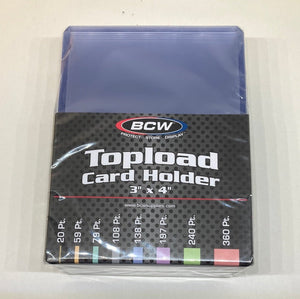
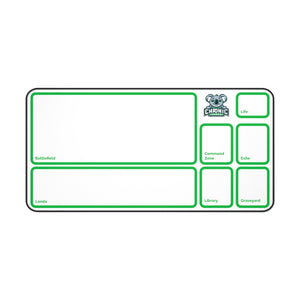
A playmat and sleeves are optional, but they protect your cards. Shop our TCG playmats, design a custom playmat, or read what a trading card game playmat is. We also carry card sleeves and toploaders.
Magic: The Gathering Card Types
On most cards, the mana cost is printed in the upper right corner. Lands are played for free. Every other card is cast as a spell and paid for with mana.
| Card type | What it does | When you can play it |
|---|---|---|
| Land | Makes mana. Tap a basic land for one mana of its color: Plains (white), Island (blue), Swamp (black), Mountain (red), Forest (green). | One land per turn, during your main phase |
| Creature | Attacks and blocks. Power is the damage it deals in combat. Toughness is the damage needed to destroy it. | Your main phase |
| Sorcery | A one-time effect. After it resolves it goes to your graveyard. | Your main phase |
| Instant | A one-time effect, like a sorcery. | Any time you have priority, including on your opponent's turn |
| Enchantment | Stays on the battlefield. An Aura is an enchantment that attaches to another card or a player. | Your main phase |
| Artifact | Stays on the battlefield. Equipment is an artifact that attaches to a creature. | Your main phase |
| Planeswalker | Enters with loyalty counters. On each of your turns you can activate one of its loyalty abilities. It can be attacked. | Your main phase |
| Battle | Enters with defense counters. It can be attacked, and damage removes its counters. | Your main phase |
Creatures, enchantments, artifacts, planeswalkers, battles and lands are permanents, i.e. they stay on the battlefield. Instants and sorceries do not.
How to Set Up a Game
- Decide who goes first with any method you both agree on, such as a coin flip or a die roll.
- Shuffle your deck. It becomes your library.
- Set your life total to 20.
- Draw seven cards.
- If you do not like your hand, take a mulligan: shuffle it back, draw seven new cards, then put one card on the bottom of your library for each mulligan you have taken.
Turn Structure: The Five Phases
You do not take actions in any order you like. Every turn runs through the same five phases:
| Phase | Steps | What you do |
|---|---|---|
| 1. Beginning | Untap, upkeep, draw | Untap your cards, then draw a card. In a two-player game, the player who goes first skips the draw on their first turn. |
| 2. First main phase | None | Play a land and cast spells. |
| 3. Combat | Beginning of combat, declare attackers, declare blockers, combat damage, end of combat | Attack with your creatures. Your opponent chooses blockers. Damage is dealt. |
| 4. Second main phase | None | Cast more spells. Play your land for the turn if you have not yet. |
| 5. Ending | End, cleanup | Discard down to seven cards. Damage on creatures is removed. |
Three timing rules cover most of a beginner's game:
- One land per turn. You can normally play one land during your turn, in either main phase.
- Tap for mana. Tapping means turning a card sideways. Tap lands to make mana and spend it on spells. Your cards untap at the start of your next turn.
- Instants are the exception. Creatures, sorceries, enchantments, artifacts, planeswalkers and battles are cast in your main phase. Instants can be cast any time you have priority.
How Combat Works
In your combat phase you choose which of your untapped creatures attack, and they tap. A creature cannot attack unless you have controlled it continuously since your turn began. Players call this "summoning sickness." A creature with haste ignores it.
The defending player then chooses which of their untapped creatures block. An unblocked creature deals damage equal to its power to the player it is attacking, and that player loses that much life. A blocked creature and its blocker deal damage to each other. A creature that takes damage equal to or greater than its toughness is destroyed.
How to Win (and Lose)
You win when your opponent has lost the game. A player loses when:
- Their life total is 0 or less.
- They have to draw a card and their library is empty.
- They have ten or more poison counters.
- They concede.
Some cards also state that a player wins or loses the game. In Commander, each player starts at 40 life, and a player who has been dealt 21 or more combat damage by the same commander loses.
Common Magic: The Gathering Deck Strategies
Players group decks into a few broad archetypes:
- Aggro: tries to take the opponent from 20 life to 0 as quickly as possible.
- Control: avoids racing. It slows the game down and wins through attrition.
- Combo: uses the interaction of two or more cards to win on the spot or build an overwhelming advantage.
- Midrange: controls the early game, then plays its threats once it has four to six mana.
Sources
- How to Play (Wizards of the Coast)
- Magic: The Gathering Comprehensive Rules (Wizards of the Coast)
- Magic formats (Wizards of the Coast)
- Commander format (Wizards of the Coast)
- Magic: The Gathering (Wikipedia)
- Magic: The Gathering deck types (Wikipedia)
Shop the Setup
Gear from this article — custom-printed and shipped in 2–4 business days.