The Growth of Sports Card Grading Services and Their Role in Determining Card Values
Richard WeissKey Takeaways
- The four major card grading companies are PSA (launched 1991), SGC (opened July 1998), BGS (opened 1999) and CGC Cards (launched in 2020 as CGC Trading Cards).
- Collectors, the parent company of PSA, acquired SGC in February 2024 and announced an agreement to acquire Beckett in December 2025. All three still grade under their own brands.
- According to grading tracker GemRate, PSA graded more than 18.3 million cards in 2025 through mid-December. CGC Cards graded 4.7 million, SGC 1.4 million and Beckett nearly 790,000.
- All four companies grade on a 1 to 10 scale. BGS adds four subgrades, and CGC Cards has two 10s: Gem Mint 10 and Pristine 10.
- As of October 6, 2026, Beckett's website and app are offline, and only Express grading submissions are open through a temporary form.
Table of Contents
Card grading services authenticate a card, grade its condition on a 1 to 10 scale, and seal it in a labeled holder. That grade is the main thing buyers use to price a card. PSA is the largest of the four major grading companies by a wide margin, and its parent company, Collectors, now also owns SGC and Beckett.
The Major Card Grading Companies
| Company | Founded | Scale | Known for |
|---|---|---|---|
| PSA (Professional Sports Authenticator) | 1991 | 1 to 10, with half-point grades such as 8.5 | The highest grading volume. Its top grade is Gem Mint 10 |
| SGC | July 1998 | 1 to 10 since 2018. It used a 1 to 100 scale before that | Part of Collectors since February 2024 |
| BGS (Beckett Grading Services) | 1999 | 1 to 10, with half points | Subgrades for centering, corners, edges and surface, plus the Black Label |
| CGC Cards | 2020, as CGC Trading Cards | 1 to 10, with half-point grades | Two grades of 10: Gem Mint 10 and Pristine 10 |
Beckett itself was founded in 1984 as a publisher and opened Beckett Grading Services in 1999. CGC Trading Cards launched in July 2020 to grade Pokémon and Magic: The Gathering cards. In June 2023 its parent, the Certified Collectibles Group, announced that it would combine CGC Trading Cards with its sports card grader, Certified Sports Guaranty (CSG), under the name CGC Cards.
How Grading Services Grew
PSA launched in 1991 as a business dedicated to grading trading cards. Sports Collectors Digest points to the summer and fall of 1998 as the turning point, when the Mark McGwire and Sammy Sosa home run race and the rise of eBay changed card collecting. SGC opened in July 1998, and Beckett opened its grading service the next year.
The volume numbers show how far grading has come since then:
- PSA had graded 23.76 million items in total as of December 30, 2014, according to Sports Collectors Digest.
- In 2025 alone, PSA graded more than 18.3 million cards through mid-December, according to GemRate figures reported by cllct.
- Over the same period of 2025, CGC Cards graded 4.7 million cards, SGC graded 1.4 million and Beckett graded nearly 790,000.
Who Owns the Grading Companies
Three of the four major graders now share one owner. Collectors, the parent company of PSA, acquired SGC in February 2024 and announced an agreement to acquire Beckett in December 2025. When the Beckett deal was reported in December 2025, cllct wrote that PSA, SGC and Beckett combined for roughly 79% of the overall grading market.
Collectors said Beckett would continue to operate as its own independent brand. CGC Cards is part of the Certified Collectibles Group, which also owns the coin grader NGC and the paper money grader PMG.
Beckett's Status in October 2026
We checked Beckett's site on October 6, 2026. It shows a maintenance notice that says Beckett.com and the Beckett mobile app are temporarily offline. The notice says Express card grading submissions remain open through a temporary submission form and that Base and Standard submissions are temporarily paused. It does not give a date for when those services will return. Check the notice yourself before you plan a BGS submission.
How Cards Are Graded
The process is similar at each company. Sports Collectors Digest described it for PSA and SGC:
- Authentication: the company first checks that the card is authentic and has not been altered.
- Grading: at least two graders examine each card. At PSA, a third grader steps in if the first two disagree.
- Encapsulation: the card is sealed in a holder with its grade on the label. Collectors call that holder a slab.
Graders look at four main things:
- Centering: how evenly the image sits inside the borders.
- Corners: sharp corners grade higher than soft or frayed ones.
- Edges: chipping, fraying and dents lower the grade.
- Surface: scratches, creases, print defects and stains lower the grade.
Grading Scales
All four companies use a 1 to 10 scale, and the differences are at the top.
- PSA: the scale runs from PSA 1 (Poor) to PSA 10 (Gem Mint), with half-point grades such as 8.5.
- BGS: centering, corners, edges and surface each get their own subgrade. A 9.5 is Gem Mint. A BGS Black Label is a Pristine 10 with a perfect 10 in all four subgrades.
- CGC Cards: there are two 10s. CGC defines a Pristine 10 as "a virtually flawless card to the naked eye" with 50/50 centering. A Gem Mint 10 is a 10 overall where one grading criterion falls short of Pristine.
- SGC: a 1 to 10 scale since 2018.
How Grading Affects Card Values
A grade does three things for a card's value:
- It confirms the card is real. Authentication comes before the grade, which protects buyers from counterfeit and altered cards.
- It gives condition a number. Two copies of the same card can sell for very different prices depending on the grade, and a number lets a buyer compare them without seeing the card in person.
- It makes the card easier to sell. A buyer can look up the certification number on the grading company's website and check that the card matches.
Record sales show how this works. Each sale in our lists of the most valuable sports cards and the most valuable baseball cards is reported with the grade and the grading company named.
Pop Reports and Gem Rates
A pop report (population report) is a grading company's count of how many copies of a card it has graded at each grade. It only counts cards that have been submitted, so the numbers rise over time.
The gem rate is the share of a card's graded copies that earned the top grade. You get it by dividing the number of 10s by the total graded. A low gem rate means the card is hard to get in top condition. GemRate is also the name of the third-party tracker that reports grading volume across the major companies.
Before You Submit a Card
Grading fees, service levels and turnaround times change often, so check each company's site on the day you submit. For the steps, read how do I grade my sports cards.
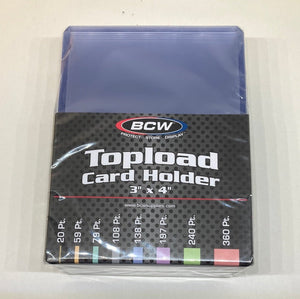
Until a card is graded, its condition is in your hands. Keep it in a penny sleeve and a rigid holder. We carry card sleeves and toploaders for that.
Sources
- About PSA
- PSA Grading Standards
- History of grading cards: PSA, BGS, SGC (Sports Collectors Digest, July 9, 2020)
- Card grading: inside the process with PSA and SGC (Sports Collectors Digest, January 21, 2015)
- Collectors, PSA acquire card grading rival SGC (Sports Collectors Digest, February 29, 2024)
- Beckett acquired by PSA parent company (Sports Illustrated, December 15, 2025)
- PSA parent company Collectors acquires Beckett (cllct)
- Beckett maintenance notice (checked October 6, 2026)
- CGC Cards Grading Scale
- About CGC Cards
- CGC Trading Cards and CSG will combine (CGC, June 20, 2023)
- CGC launches CGC Trading Cards division (Greysheet, July 7, 2020)
Shop the Setup
Gear from this article — custom-printed and shipped in 2–4 business days.